Technical Guides
Solid State Relay Use Cases: Where SSRs Deliver in Real Production
Where do solid state relays actually deliver? Six production use cases: PID heating control, frequent start-stop duty, PLC output switching, lighting, harsh environments, and three-phase heaters.
On most heating and automation panels, the solid state relay is often the smallest device on the drawing — and the one that switches the most often. That combination is exactly where SSRs belong: loads switched all shift long, and sites where a switching spark would be a hazard. The use cases below cover where SSRs deliver in real production, with the DREL SSR480D and the SSR-3 three-phase series as reference hardware.
What an SSR Is, in One Paragraph
A solid state relay is a contactless electronic switch: a weak, electrically isolated control signal turns a strong AC circuit fully on or fully off through semiconductor switching instead of mechanical contacts. The SSR480D takes a 3-32 VDC input and switches a 40-480 VAC load at a 40 A rating in a zero-crossing design. Because there are no contacts to arc, wear or weld, an SSR is built for frequent start-stop duty and the constant on-off cycling of temperature control.
Use Case 1: Heating Control with a PID Temperature Instrument
The classic application. A PID temperature instrument decides when the heater needs power, and the SSR executes that decision, switching electric heating wires and heater elements in injection molding machine barrels, ovens and industrial furnaces. Temperature control never rests: the load is cut in and out continuously. A mechanical contact arcs and erodes on every cycle; a contactless SSR simply absorbs them, which is why SSRs are the usual companion to PID instruments on heating panels.
Use Case 2: Frequent Start-Stop and Temperature-Cycle Switching
More generally, the SSR is first of all an on-off switch, and its natural habitat is equipment that starts and stops many times per shift. Every closure of a mechanical relay contact produces a spark and a little wear; an SSR produces neither, because nothing inside moves. Operation is silent, and service life is not consumed by the number of switching cycles — the properties that matter most in constant start-stop and temperature-cycling duty.
Use Case 3: The Output Actuator for PLC Automation
In automated systems the SSR sits at the end of the control chain. A PLC output is a micro-power DC signal — the SSR480D accepts 3-32 VDC directly — and the relay uses that weak signal to drive a high-power AC load. One small output point can switch heaters or other AC equipment without an intermediate contactor stage, while the isolation between control side and load side keeps the low-voltage side apart from the mains.
Use Case 4: Small Motors and Stage or Signal Lighting
Not every SSR load is a heater. The same class of relay controls small AC motors, and it is used on stage lighting and signal lamps — loads switched frequently by nature. Lighting is an especially natural fit: the switching is constant and often rapid, and with no moving parts it is completely silent, while a mechanical relay audibly clicks and wears on every operation.
Use Case 5: Harsh, Damp and Corrosive Environments
In chemical plants, coal-mining installations and other locations that require explosion protection, the spark of a mechanical contact is a hazard in itself. An SSR has no mechanical contacts, so it produces no switching sparks — safer than a conventional relay in these locations. It also copes better with damp or corrosive sites: the internal assembly is potted in epoxy resin against moisture and vibration, inside a flame-retardant engineering plastic shell. Dust and humidity make the same argument.
Use Case 6: Three-Phase High-Power Heating — and Where SCRs Take Over
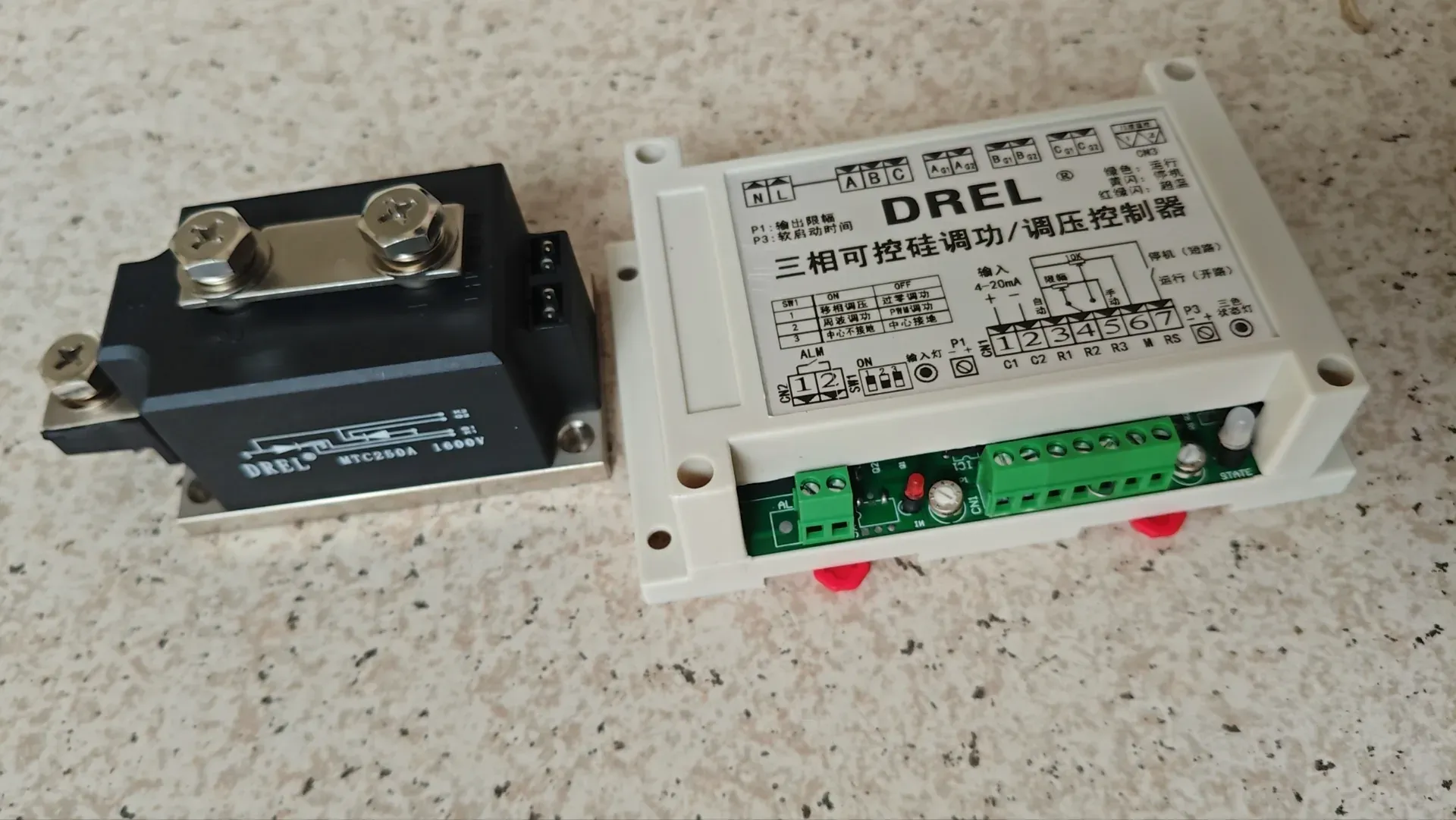
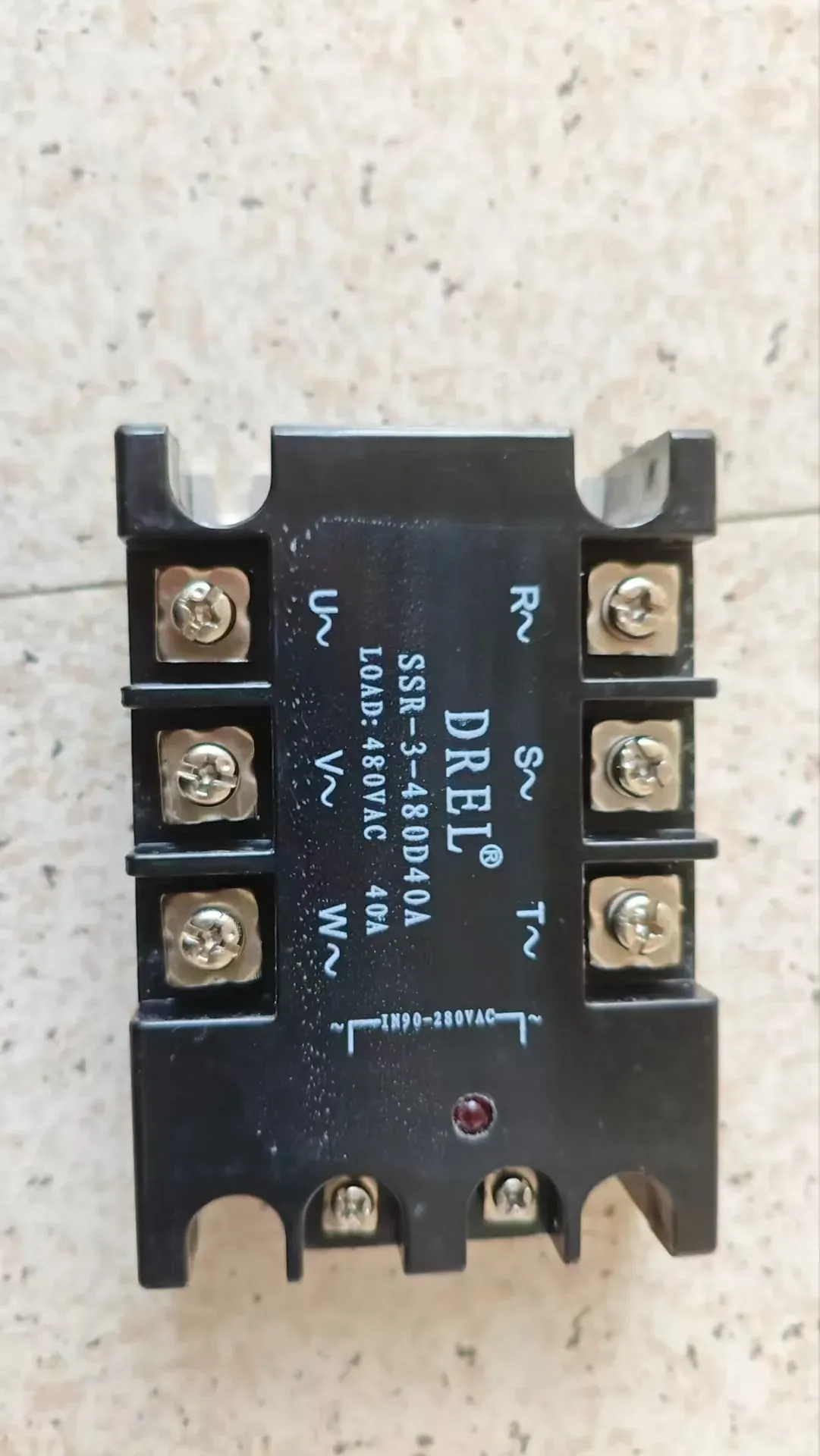
For three-phase heaters, the SSR-3 series switches all three lines: terminals R/S/T on the line side feed U/V/W on the load side, with load ratings from 25 A to 100 A at 480 VAC and a 90-280 VAC control input. That suits furnace, heat-treatment and extrusion panels where the load is switched rather than modulated. The boundary matters: when a process needs continuously adjusted power — as in salt-bath, quenching, annealing or sintering furnaces and tunnel kilns — that is the job of an SCR power-control system such as the DREL MTC, not an SSR.
Buyer tip: check the control input before wiring. The three-phase SSR-3 series takes a 90-280 VAC input, while the single-phase SSR480D takes 3-32 VDC with positive and negative polarity — the two families are not wired the same way.
Three Checks Before You Order
Whatever the use case, three checks apply. First, derate the current: the 40 A rating on the SSR480D is a ceiling, and real loads should run below it. Second, plan cooling: at high current the semiconductor generates substantial heat, so the relay must be mounted on a metal heatsink with thermal grease applied — skip that, and the device will burn out. Third, protect inductive loads: when the SSR drives a motor or any inductive load, fit an RC snubber or a varistor across the output to absorb surges — and never short the output terminals.
Match the Relay to the Load
The pattern is consistent: an SSR is the right device when the job is switching — heaters cycled by a PID instrument, frequent start-stop loads, PLC outputs, lighting, and panels in harsh environments — while an SCR system takes over when the job is continuous power regulation. If you can state your load voltage, load current and control signal, the rest follows quickly. Contact us to match an SSR to your load.